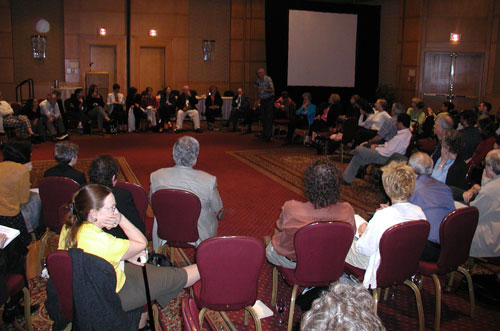
The 2004 Annual Meeting of the Jean Piaget Society will focus on Social Development, Social Inequalities, and Social Justice. The meeting is organized by Cecilia Wainryb, Elliot Turiel, and Judith Smetana and will take place in Toronto from June 3-5, 2004. The plenary speakers are Martha Nussbaum (University of Chicago), Claude Steele (Stanford University), Elliot Turiel, Presidential Address (University of California, Berkeley), Unni Wikan (University of Oslo), and Edward Zigler (Yale University). This meeting brings together scholars from different disciplines to discuss their ideas and research on social hierarchies and social justice and to connect those ideas to theory and research on social development.
In turn, theory and research from social and developmental psychology inform philosophical analyses of social justice and anthropological analyses of social hierarchies within cultures. Social psychological research has examined the effects of inequalities, such as minority status and stigma, on social behavior and competence. There have also been large-scale attempts, through intervention studies and social policies, to address societal inequalities and social injustices, and the effects of these interventions have been brought to bear on our understanding of children’s social development. Developmental studies have examined the origins of social opposition in childhood and social judgments leading to scrutiny of social practices. They also have examined conflicts around practices judged unfair, discontents on the part of those in lower or subordinate positions in the social hierarchy, and a multiplicity of orientations to social interactions and societal arrangements that defy generalizations regarding cultural orientations. This meeting will bring together these different philosophical, anthropological, and psychological perspectives for discussions on interrelated topics that have been addressed within each discipline.
Sneak Preview: JPS 2005 – Social Life & Social Knowledge – Vancouver, Canada |
|||||||||||||||||||








 In
recent years, there has been resurgence of concern among philosophers
and social scientists with issues of social justice as they
pertain to social hierarchies embedded in societal arrangements
and cultural practices. Philosophers and anthropologists have
approached the study of social hierarchy and social justice
on the assumptions that human reasoning is central to morality,
that people make judgments about cultural practices, and that
conflicts and discontents exist in the context of inequalities
and injustices. These are issues with substantive psychological
components that have been addressed in recent research by developmental
and social psychologists, who have documented the distinct
orientations of people who are situated in different positions
in society, such as women, people of lower socio-economic classes,
and minorities.
In
recent years, there has been resurgence of concern among philosophers
and social scientists with issues of social justice as they
pertain to social hierarchies embedded in societal arrangements
and cultural practices. Philosophers and anthropologists have
approached the study of social hierarchy and social justice
on the assumptions that human reasoning is central to morality,
that people make judgments about cultural practices, and that
conflicts and discontents exist in the context of inequalities
and injustices. These are issues with substantive psychological
components that have been addressed in recent research by developmental
and social psychologists, who have documented the distinct
orientations of people who are situated in different positions
in society, such as women, people of lower socio-economic classes,
and minorities.